
Match Summary:
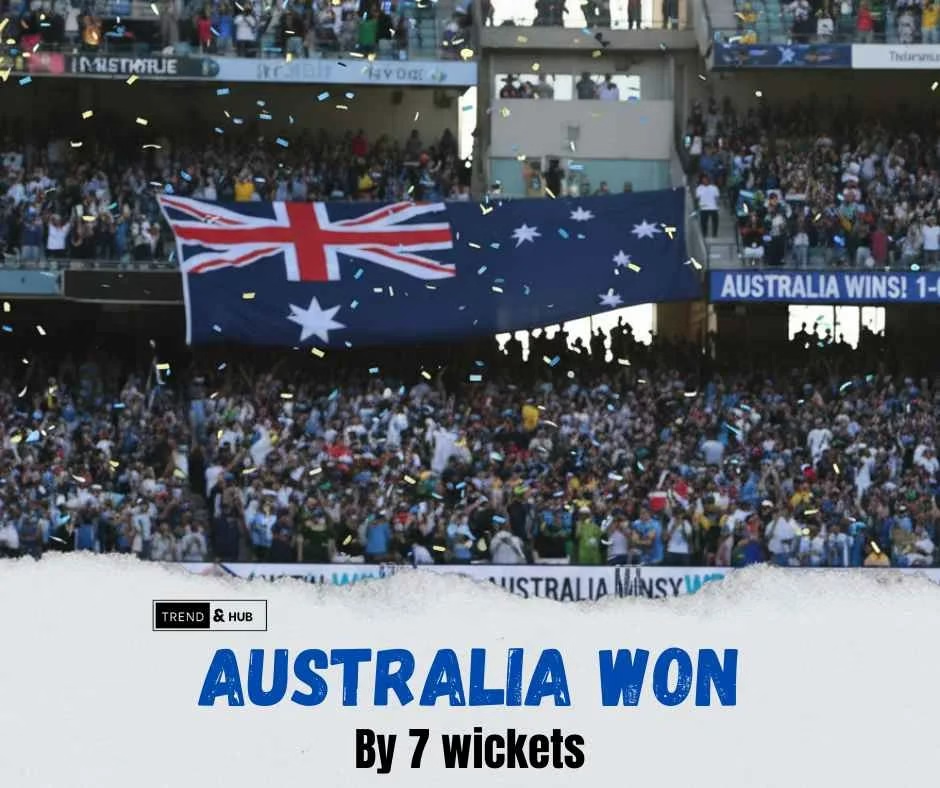
High hopes for explosives welcomed the first India vs Australia ODI, but it soon devolved into a contest of skill and flexibility. Due to persistent rain, the match was reduced to 26 overs per side using the DLS technique. Australia won the toss and decided to bowl first, a decision that proved successful right away. In order to disrupt India’s partnerships and control the scoring rate, their bowlers hit early and frequently. India ended off with a below-average total and never recovered. Australia easily won by 7 wickets in reply after chasing the score with force. Player of the Match went to captain Mitchell Marsh, who led from the front with an undefeated record and astute leadership.
Toss and conditions:
The promise of chasing in a shorter game, the fresh pitch, and the overcast weather persuaded Australia to bowl first. Josh Hazlewood and Mitchell Starc took full advantage of the circumstances, hitting India’s top order right away with a forceful swing of the new ball. During the powerplay, wickets fell frequently as a result of their relentless accuracy, which left batsmen guessing. Australia won the match right away thanks to their brave choice to bowl first.
India’s Batting:
India failed to establish a rhythm when batting first in difficult, seaming conditions. Rain delays just increased the uncertainty, and the innings lacked rhythm and purpose. Virat Kohli (0) and Rohit Sharma (8) left early, adding to India’s consistent issue with top-order failures in international ODIs.
KL Rahul put in significant effort to keep the innings steady, scoring a tough 38 off 31 balls, but he didn’t get much support from the other side. Unrelenting, disciplined bowling and exact short balls dismissed Shubman Gill (12) and Shreyas Iyer (11) after promising starts.
India could only muster 136 for 9 in 26 overs, despite Nitish Kumar Reddy’s explosive 19 from 11 balls giving the batting a temporary boost. Australia’s bowlers dominated the pace, movement, and brutal accuracy of the game on a vibrant Perth pitch, leaving India scrambling.
Australia Bowling:
Australia’s bowlers established the tone for the game with an unrelenting show of pace and control from the very first ball. With a planned attack on India’s top order, Mitchell Starc, Josh Hazlewood, and Mitchell Owen combined incisive short balls with deft pace changes.
Hazlewood delivered the initial punch, dismissing Rohit Sharma ahead of schedule and instantly putting pressure on India. Owen tightened the screws in the middle overs, giving up little and taking two crucial wickets, while Starc maintained the momentum by dismissing Virat Kohli for a duck.
Matthew Kuhnemann kept up the pressure in the spin department by bowling accurately and preventing the Indian hitters from releasing their arms. India’s irritation increased with each stop, dive, and catch as Australia’s fielders effectively supported their bowlers. They made India’s modest total appear even lower with their fine ground fielding and vigilant catching, which saved vital runs.
Australia Batting: Marsh Leads the Chase
Chasing a DLS-adjusted target of 131, Australia took control from the start. Though Travis Head fell early, the visitors never lost momentum. Josh Philippe (37 off 29) set the tempo, attacking anything short or wide and putting India’s bowlers on the back foot.
Captain Mitchell Marsh (46 off 52)* steadied the innings with authority, blending clean hitting with smart strike rotation. Matt Renshaw (21 off 24)* joined him to guide Australia home in just 21.1 overs, wrapping up a dominant seven-wicket victory.
The chase showcased Australia’s trademark composure and precision. They built partnerships, rotated the strike intelligently, and punished every loose delivery—executing their plan with total control and maturity.
India Bowling:
While defending a small total, India’s bowlers launched a fierce attack but were unable to change the outcome of the match. India’s hopes were briefly raised when Arshdeep Singh opened with a bang, dismissing Travis Head early with speed and bounce. But as Australia’s batters launched a counterattack and the runs started to come in, Mohammed Siraj found it difficult to keep up the pressure.
Axar Patel and Washington Sundar kept things tight in the middle overs but were unable to make any progress. Australia dominated the chase because they were unable to generate a turn or apply consistent dot-ball pressure.
India’s lack of penetration and variety was the true problem. Australia easily took advantage of the bowlers’ one-dimensional appearance due to the short target they had to defend.
Player of the Match: Mitchell Marsh

Mitchell Marsh’s declaration of Player of the Match left no space for question. In trying circumstances that required both skill and patience, he crafted an undefeated 46 off 52 balls to lead Australia’s charge from the front. Marsh was an expert at reading the game, guiding his side with authority and modifying his pace to fit the circumstances.
In his capacity as captain, he skillfully planned every move, from deft field placements to quick bowling changes, keeping India under continual strain. Once again, his decisive batting and composed leadership demonstrated how crucial he was to Australia’s win in the restricted overs. Marsh is one of the most complete and reliable all-rounders in world cricket, demonstrating his ability to perform well under duress.
Looking Ahead: What to Expect in the Second ODI
The India vs Australia second ODI is set for 23 October 2025 at the Adelaide Oval, where both teams will look to adjust their approach and seize momentum.
India has a lot to fix going into the game. To establish relationships and set the tone early, the squad needs its top order, particularly Virat Kohli and Rohit Sharma. The middle order must handle Australia’s pace attack with greater intent and rotate strikes more effectively. India might gain greater flexibility and balance by switching up their batting lineup or adding an extra all-rounder.
Australia will want to maintain the pressure after their convincing win in Perth. Their top order has the depth to either score or chase down large totals, and their bowling attack appears to be precise and well-coordinated. The Australians are full of confidence and will try to finish the series before the last ODI in Sydney.
Although the weather may affect the match once more, both teams will be eager to play the entire 50 overs, which would be a true test of strategy, depth, and tenacity in this intensely contested India vs Australia ODI series.
Conclusion:
The hosts made a strong statement in the opening India vs Australia ODI 2025. Australia confirmed the traits that characterize their cricketing success by dominating with disciplined bowling, excellent fielding, and calm leadership. In contrast, India appeared unprepared and rusty, finding it difficult to keep up with Perth’s bounce, pace, and movement.
Australia has a 1-0 lead, but the series is still very much up in the air. Although they must swiftly adjust, demonstrate determination with the bat, and match Australia’s effort, India has the skill and will to fight back. The forthcoming ODI in Adelaide promises to be another exciting chapter in this legendary rivalry, one that is fueled by pride, pressure, and unadulterated passion as both teams strive for supremacy.
Australia defeated India by seven wickets in a rain-affected 26-over match to win the opening ODI of the 2025 series in Perth.
Because of his exceptional all-around leadership and game-winning, undefeated 46 off 52 balls, Mitchell Marsh was named Player of the Match.
The second ODI will be played on 23 October 2025 at the Adelaide Oval.