
Introduction:
Prime Minister Shehbaz Sharif of Pakistan made the historic announcement of $8.5 billion in investment agreements with China at the Shanghai Cooperation Organisation (SCO) Summit 2025 in Tianjin. Targeting important industries like steel, renewable energy, electric vehicles (EVs), agriculture, and health, they include $1.5 billion in joint ventures (JVs) and $7 billion in memorandums of understanding (MoUs). This infusion, which signifies the official start of CPEC 2.0 amid growing economic difficulties, signals a new phase of the China-Pakistan Economic Corridor and strengthens bilateral ties through common developmental goals.
Background: SCO Summit as the Catalyst:
The Presidents of member states gathered at the SCO Summit 2025 to strengthen economic cooperation and establish strategic alliances, providing a crucial venue. The conference provided China and Pakistan with a chance to strengthen their relationship. The Beijing agreement was a notable example of long-term diplomatic cooperation, even if geopolitical tensions were simmering elsewhere in the forum.
Prime Minister Shehbaz Sharif took use of this opportunity to publicly introduce CPEC 2.0, promising Chinese investors quick facilitation and improved security while attempting to remove administrative barriers through Pakistan’s Special Investment Facilitation Council (SIFC).
Breakdown of the $8.5 Billion Agreement:
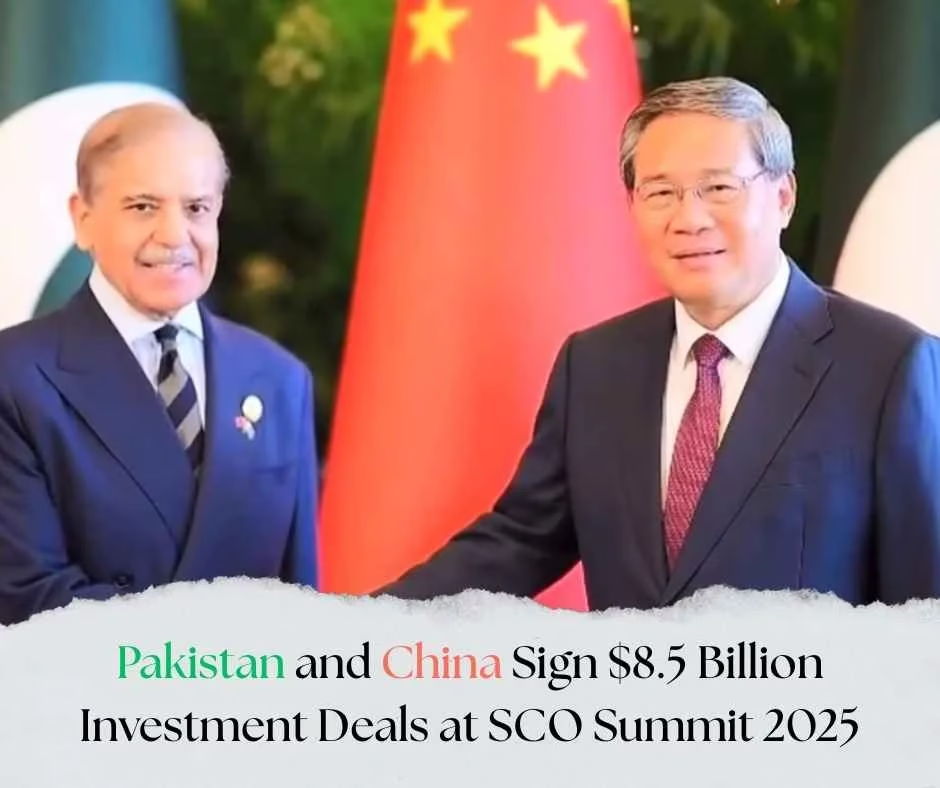
The financial package consists of $1.5 billion in joint ventures and $7 billion in agreements of understanding, distributed among industries including
- Farming
- Renewable energy (hydropower, wind, and solar)
- EVs, or electric vehicles
- Biotechnology and health
- Steel, petrochemicals, and chemicals.
Over 2,500 B2B discussions took place in nine sectors during the Second Pakistan–China B2B Investment Conference in Beijing (on the edge of the SCO summit), resulting in hundreds of Memorandums of Understanding and 21 agreements.
Prime Minister Shehbaz Sharif promised quicker implementation and the creation of jobs, framing this progress as a “long march of economic development”. In order to describe Pakistan-China relations, he used metaphors such as “stronger than steel, sweeter than honey, deeper than the oceans, and higher than the Himalayas.”
Economic Impact on Pakistan:
The $8.5 billion infusion has the potential to change Pakistan’s economic course:
- Job Creation: It is anticipated that the industries of agriculture, industry, EV manufacture, and health will generate thousands of new jobs.
- Sectoral Diversification: Pakistan’s long-standing reliance on agriculture is broken by investments in high-growth industries including renewable energy, electric vehicles, information technology, and health.
- CPEC 2.0 Infrastructure Revamp: Pakistan wants to increase connectivity and industrial productivity by revitalising its rail, road, and Special Economic Zone (SEZ) infrastructure corridors.
Challenges and Security Considerations:
Despite the hope, a number of obstacles still exist:
- Chinese worker security: Chinese nationals working on CPEC projects are still at risk of being the target of militant attacks. Particularly in response to pressure from Beijing, Pakistan has promised to increase security.
- Implementation bottlenecks: Investor confidence might be damaged by red tape-induced delays. PM Sharif personally pledged to remove administrative roadblocks, pointing to the 24-hour turnaround time for a Chinese business owner.
- Uncertainties about funding: Not every initiative has a guarantee. For example, China decided not to fund the Karachi–Rohri railway, forcing Pakistan to look for ADB assistance, which may have an impact on the entire plan for CPEC.
Geopolitical Context and Regional Implications:
This deal highlights Pakistan’s strategic dependence on China in the face of shifting international alliances
- India, despite attending the SCO Summit, expressed worries about the BRI’s circumvention of sovereignty, subtly criticising initiatives such as CPEC.
- In line with China’s larger vision of multipolarity, regional players (such as Russia and Iran) demanded during the summit SCO-centric development tools and collaborative economic instruments in addition to bilateral dynamics.
- To maintain momentum in the face of financial constraints, Pakistan must continue to diversify its sources of investment and fortify its intraregional relationships.
Conclusion:
An important turning point for Pakistan’s economic recovery was the $8.5 billion in investment agreements signed during the SCO Summit 2025. In addition to launching CPEC 2.0, it restores confidence in Pakistan’s aspirations for infrastructure and industry. These investments might spur economic diversification and job development in a variety of industries, including agriculture and electric vehicle production. Their success, however, depends on Pakistan’s capacity to guarantee operational effectiveness, investor security, and conformity to geopolitical realities. The resurrected CPEC, a key component of the Belt and Road Initiative, presents both opportunities and a challenging test of strategic execution.